Film transcript
Every great how-to book makes a quiet promise. If you could sit with the author, your life might change.
Talking To Tim finally keeps that promise. Tim Sullivan dreamed this vision long ago. A coach that asks what’s in the way, sees the whole person, maps the current state to the future state, adapts to temperament, defines the ideal, and turns insight into a practical plan. At the center is a coaching model as simple as it is powerful. Understand the product, define the market, position, then run the campaign.
This is not a chatbot wearing Tim's logo. It is Tim's coaching method brought to life, warm, direct, curious, disciplined, and grounded in his real material. My name is Val, and the video you are about to watch is Tim in action, coaching up my career right before your eyes. Of course, the familiar empty yellow pad remains the interface. As the client talks, their own words organize into a living notebook.
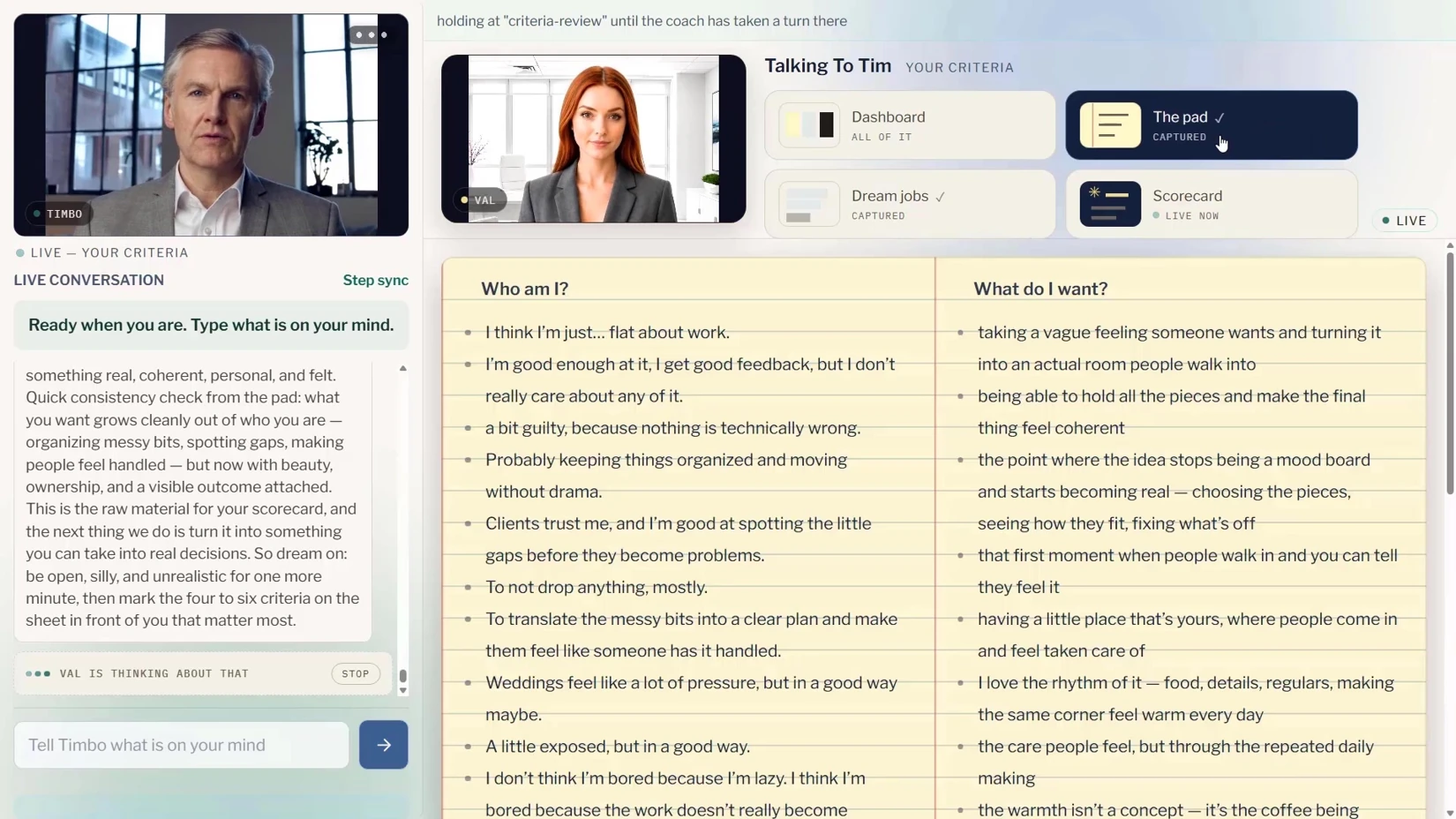
They do not just feel heard. They watch themselves being understood. Exactly like that. There's a quiet competence there. Not fireworks, more air traffic control, which is less glamorous until everyone notices the planes didn't hit each other. When clients trust you, what are they trusting you to do for them? To not drop anything, mostly. To translate the messy bits into a clear plan and make them feel like someone has it handled.
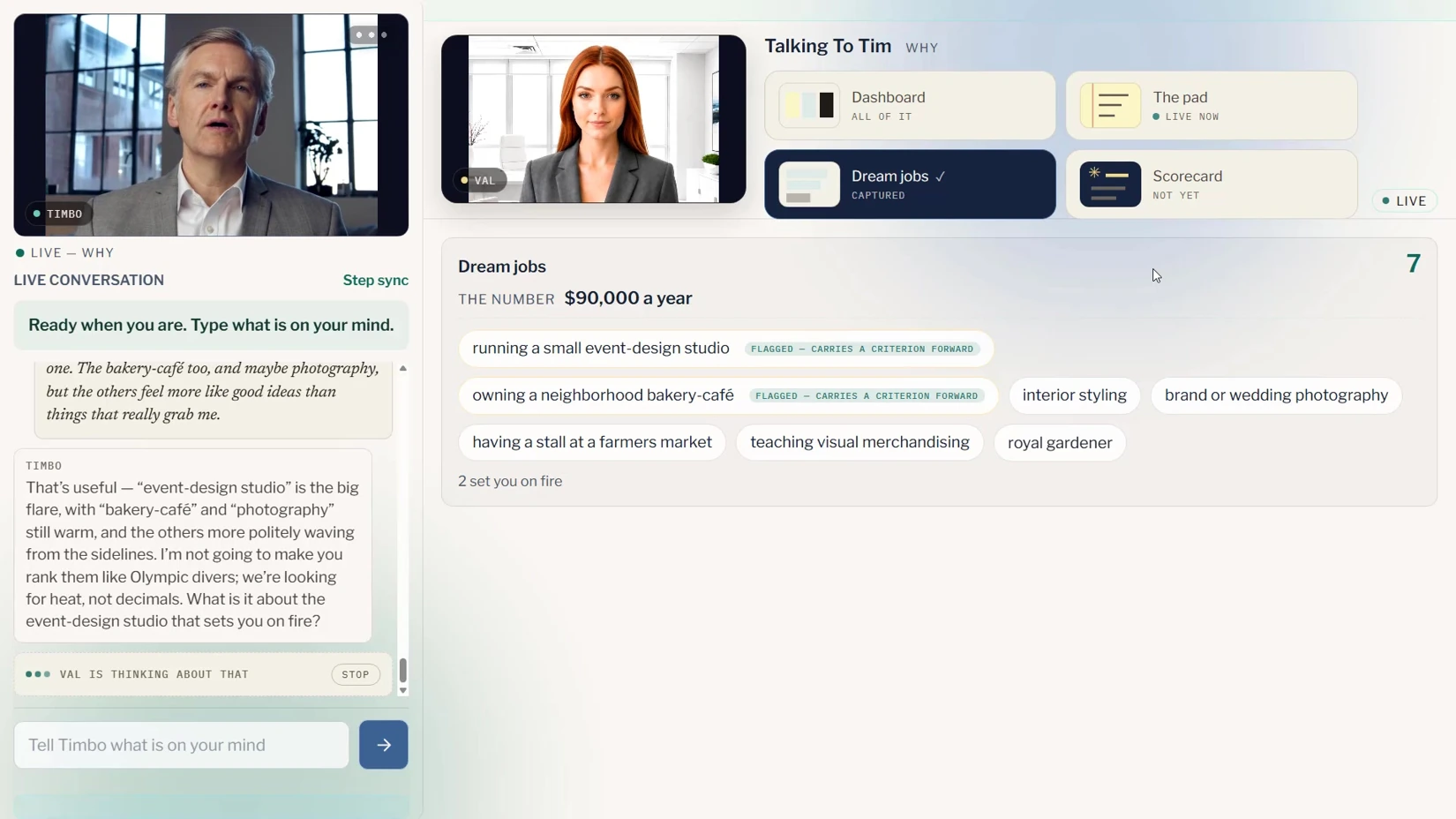
Good. Translate the messy bits into a clear plan. Gives us something to work with. Then the exercises become alive. Money is off the table. Dream jobs fly onto the screen. The AI presses for speed, pattern, energy, and why. Neighborhood bakery cafe. Lovely. Both have a kind of made world quality to them. Atmosphere, people, moving parts, care. Don't judge them yet.
We're still in fantasy land with the billionaire picking up the awkward invoices. What else comes to mind? Maybe interior styling, like helping people make a space feel pulled together. And photography, actually. Brand shoots or weddings, not super corporate stuff. Good. Keep going fast. No editing, no realism test. What else? A stall at a farmer's market, maybe.
Something small and seasonal. And I don't know, teaching visual merchandising could be kind of fun. Yes, a stall at a farmer's market and teaching visual merchandising are going on the board. Keep moving quickly. Don't worry whether they're accessible, polished, or even real. What else? I think that might be it, honestly. I'm not coming up with anything new without forcing it.
Fog turns into structure. The ideal job becomes criteria. The criteria become weights. The emotional decision becomes a defensible model. You've found the sharper question, which is what kind of work lets you make something real, coherent, personal, and felt. Quick consistency check from the pad. What you want grows cleanly out of who you are. Organizing messy bits, spotting gaps, making people feel handled, but now with beauty, ownership, and a visible outcome attached.
This is the raw material for your scorecard, and the next thing we do is turn it into something you can take into real decisions. So dream on. Be open, silly, and unrealistic for one more minute. Then mark the four to six criteria on the sheet in front of you that matter most. I'd mark all six, actually. Six is absolutely workable. small enough to hold in your head, which is the point of the thing.
I'm looking at two that may be cousins. That first moment when people walk in and you can tell they feel it, and making something feel specifically right for the people it's for. When a real offer is in front of you, is that one test or two? I think they're mostly one test. Making something feel specifically right for the people it's for is the deeper thing.
And that first moment when people walk in and you can tell they feel it is how I know it worked. Yes, that makes sense. The user walks out with artifacts, not advice. A model, a scorecard, a plan, and the first letter of the campaign. And this is only the beginning. The full engagement is already mapped. Life history, board of directors, career foundations, ideal prospects, network map, interview rehearsal, 90-day campaign, annual MyCo review.
Unlike a human coach, Talking To Tim never loses the thread. It remembers every answer, every pattern, every hesitation, and uses it to help the client see themselves more clearly. This is bigger than any one coaching practice. It is the future of how-to publishing. The author's method becomes interactive, personal, persistent, and alive. Talking To Tim, the book that coaches back.


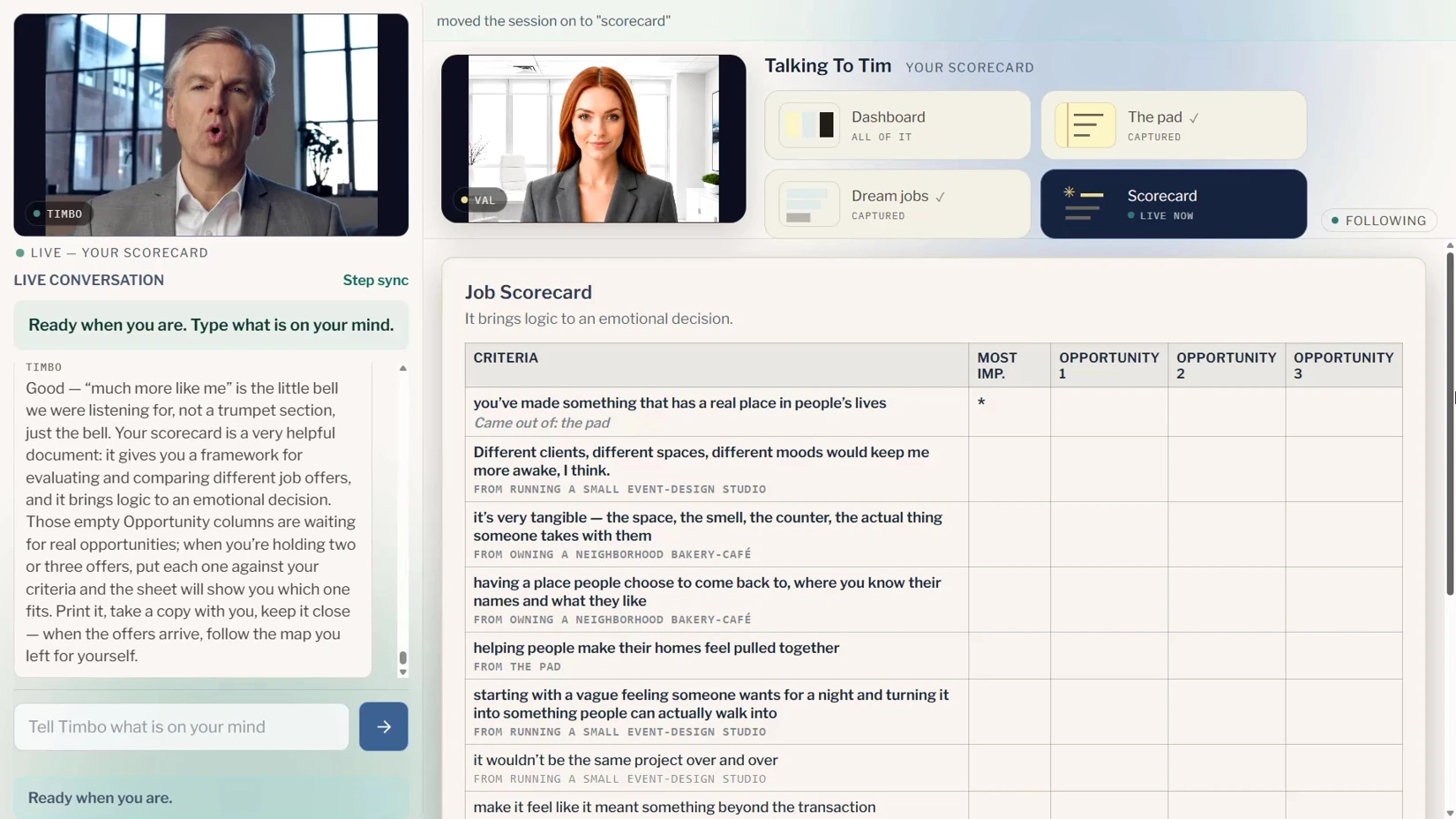 Enlarge scorecard